
DISCLAIMER: These answers provide general information about Montana law and are not legal advice. Laws and individual circumstances vary. Consult a qualified attorney about your specific situation.
In Montana, divorce is legally called a dissolution of marriage. A spouse begins the process by filing the appropriate petition in District Court; property, debts, maintenance and, when children are involved, parenting plans and child support may also need to be resolved. Montana Courts
Montana courts generally use the term parenting plan rather than simply “custody.” A parenting plan addresses where children will live, parenting time, decision-making responsibilities and other aspects of caring for the children. Montana Courts
Montana tenants have statutory rights and responsibilities involving rental conditions, repairs, landlord access, security deposits, notices and eviction procedures. Residential landlord-tenant relationships are primarily governed by Montana's Residential Landlord and Tenant Act and security-deposit laws. Montana Courts
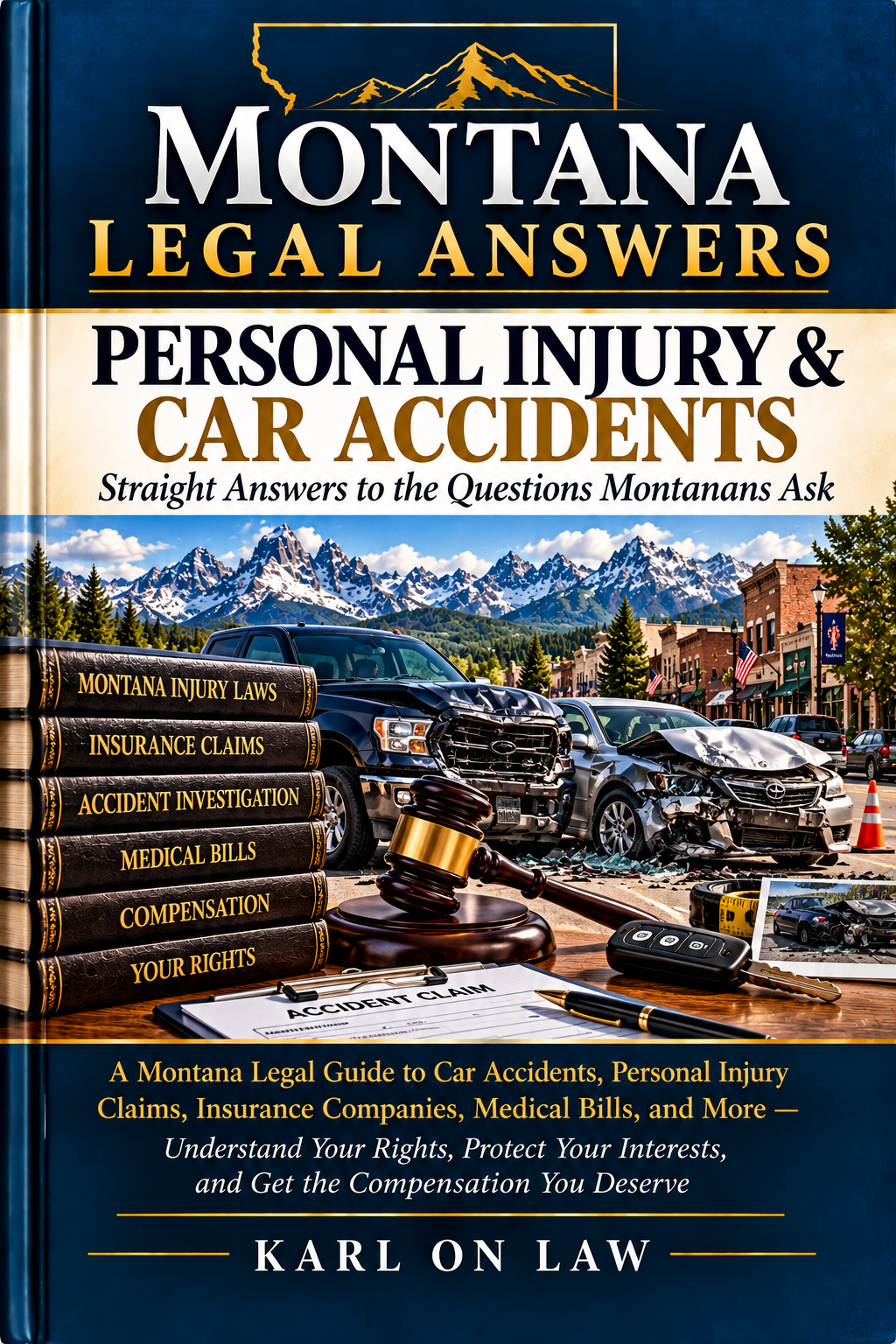
Make safety and medical care the first priorities, contact law enforcement when required, exchange information, photograph the vehicles and scene, identify witnesses, preserve records and notify your insurer. If you are injured, be cautious about settling before the nature and extent of your injuries are known.
Montana uses statewide child-support guidelines. The calculation considers the income of both parents and other factors established by Montana law and the guidelines; the current guideline tables became effective February 1, 2026. DPHHS
Yes, when lawful grounds exist, but a landlord generally must provide the legally required notice and follow Montana's court eviction process. A landlord cannot simply bypass the legal process because the landlord wants possession of the property. Montana Courts
A first DUI can result in criminal penalties, driver's-license consequences, required assessment, education or treatment, and other conditions. Montana's DUI statutes separately address first through third offenses, implied consent, license consequences and treatment requirements.
Montana law does not require everyone to have a will, but a valid will allows you to direct how probate assets should be distributed and identify people you want involved in administering your estate. Montana law recognizes witnessed and qualifying holographic wills.
Probate is the legal process for administering a deceased person's estate. It can involve validating a will, appointing a personal representative, identifying property, addressing debts and claims, and distributing remaining assets to the appropriate beneficiaries or heirs.
A person who qualifies under Montana law can petition the appropriate court for an Order of Protection. The court can impose restrictions intended to protect the petitioner from qualifying abuse, threats, stalking or other prohibited conduct.
Yes. Montana permits people to represent themselves, and the Judicial Branch provides forms for dissolution with or without children as well as joint dissolution proceedings. Whether self-representation is practical depends on the complexity of the case. Montana Courts
A Montana landlord may make deductions authorized by law, but cannot simply keep a security deposit without legal justification. Montana provides specific security-deposit rules and procedures for tenants seeking return of deposits. Montana Courts
There is no single timeline for every divorce. An uncontested case in which the spouses agree on the major issues can generally proceed more efficiently than a contested divorce involving property, children, maintenance or other disputes.
For most adult noncommercial drivers, the commonly applicable per-se alcohol concentration threshold is 0.08%. Different standards and offenses can apply depending on the driver's age, license type and circumstances.
A Montana landlord's right of access is governed by state law and the rental relationship. Notice and reasonable access requirements generally apply, although exceptions can exist for emergencies and other legally recognized circumstances.
Remain calm and do not physically resist. You generally have the right to remain silent regarding investigative questioning and the right to request an attorney; what you say can potentially become evidence.
A power of attorney is a legal document authorizing another person, called an agent, to act for you in specified matters. The document can grant broad or limited authority depending on how it is drafted.
There is no standard Montana settlement amount. Case value can depend on medical expenses, lost income, future care, disability, pain and suffering, comparative fault, available insurance and the strength of the evidence.
Yes, a court-ordered parenting plan can potentially be amended when Montana's legal requirements are satisfied. The Judicial Branch provides different procedures depending on whether both parents agree to the proposed changes. Montana Courts
A move may affect an existing parenting plan and can trigger Montana notice and court requirements. Montana's Judicial Branch provides a specific Notice of Intent to Move procedure. Montana Courts
Montana courts distribute marital property under Montana's equitable-distribution rules. The process considers statutory factors and does not necessarily mean that every asset is automatically divided exactly 50/50.
If you die without a valid will, property subject to probate is generally distributed according to Montana's intestate-succession laws rather than according to unwritten wishes.
Certain Montana misdemeanor convictions may qualify for expungement if statutory eligibility requirements are satisfied. Not every offense or record is eligible.
A refusal can carry significant consequences under Montana's implied-consent laws, including administrative driver's-license consequences. Montana law specifically addresses implied consent, testing, refusals and license suspension. Montana Department of Revenue
Many Montana personal-injury claims are subject to a three-year limitations period, but important exceptions and different deadlines can apply. The particular claim should be evaluated promptly rather than assuming a deadline.
Montana law provides a procedure for grandparent-grandchild contact in certain circumstances. Courts must consider applicable statutory requirements as well as parental rights and the child's interests. Montana Courts
It depends on the tenancy and rental agreement. A landlord's ability to change rent during a fixed-term lease differs from changing rent for certain periodic tenancies.
The required notice depends on the type of tenancy, lease terms and circumstances. Montana's Judicial Branch provides a tenant Notice of Moving Out form and landlord-tenant guidance. Montana Courts
Sometimes, but moving out does not automatically eliminate obligations under a lease. The lease terms, reason for leaving, landlord's conduct and any statutory rights or exceptions must be considered.
Divorce terminates the marriage. Legal separation can address many of the same financial, property, support and parenting issues while leaving the parties legally married.
Yes, when applicable requirements for modification are satisfied. Changes in income, parenting arrangements or other qualifying circumstances can potentially affect the support obligation.
A parent can ask the court to enforce an existing parenting plan. Montana Courts provides a Petition for Contempt to Enforce a Parenting Plan for appropriate circumstances. Montana Courts
Montana generally uses the term maintenance rather than alimony. Courts consider statutory factors when deciding whether maintenance should be awarded and, if so, its amount and duration. Montana Courts
Yes, Montana recognizes common-law marriage when its legal requirements are established. Simply living together for a particular number of years does not automatically create a common-law marriage.
Small-claims cases are generally brought in a Montana Justice Court with jurisdiction over the dispute. The claimant must properly file the claim and comply with service and hearing requirements.
Montana Courts currently states that small-claims cases may involve amounts up to $7,000. Courts of limited jurisdiction collectively handle certain ordinary civil matters up to $15,000. Montana Courts
Montana landlords have statutory duties regarding rental-property condition and maintenance. Available remedies can depend on the type and severity of the problem and whether the tenant follows required notice procedures.
A landlord generally cannot substitute self-help measures such as an unlawful lockout for Montana's legal eviction process. A tenant subjected to an unlawful exclusion may have legal remedies.
An Order of Protection is a court order designed to protect a qualifying person from certain threatening, abusive, stalking or dangerous conduct. Its specific restrictions depend on the circumstances and court's order.
Yes. Depending on the circumstances, a court can impose restrictions concerning a residence, workplace, school, communication, contact and other locations or conduct.
That depends on the authority granted in the document. An agent can exercise only powers provided by the power of attorney and applicable Montana law.
A durable power of attorney is generally designed so the agent's authority can continue despite the principal's later incapacity, subject to the terms of the document and applicable law.
A living will or advance healthcare directive communicates a person's healthcare preferences for circumstances in which the person may no longer be able to communicate those decisions personally.
A will generally directs disposition of probate property after death. A trust can own and manage property during life and after death and, when properly structured and funded, can allow certain assets to pass outside probate.
A revocable living trust is created during a person's lifetime and can generally be amended or revoked while the creator has the legal capacity and authority to do so.
Some property can pass outside probate through properly structured trusts, beneficiary designations, joint ownership and other nonprobate-transfer arrangements. Whether probate can or should be avoided depends on the estate.
Montana generally uses the term personal representative. This person administers the estate by gathering property, addressing valid claims and expenses, complying with probate requirements and distributing remaining assets.
A will may be challenged on legally recognized grounds. Possible disputes can involve execution requirements, testamentary capacity, undue influence or other questions about validity.
Potentially. Montana recognizes holographic wills when statutory requirements are met.
A conventional witnessed Montana will generally requires at least two qualifying witnesses. Montana separately recognizes holographic wills that satisfy their statutory requirements.
A felony is generally a more serious criminal offense carrying potentially greater punishment than a misdemeanor. The classification and potential sentence depend on the particular Montana statute.
A defendant who cannot afford private counsel and faces a qualifying criminal proceeding may be eligible for appointed representation through Montana's public-defender system.
An arraignment generally involves formally advising the defendant of the charges and rights and receiving a plea. Release conditions and other procedural matters may also be addressed.
A court considers applicable Montana law and the circumstances when determining pretrial release and conditions. Conditions can differ substantially depending on the charge, alleged conduct and defendant.
Miranda warnings generally become relevant before custodial interrogation. Police do not necessarily have to read Miranda warnings merely because they approach, stop or even arrest someone.
Sometimes. Warrantless vehicle searches can be lawful when a recognized exception to the warrant requirement applies, but legality depends heavily on the circumstances.
Generally, law enforcement must establish probable cause to a judge or other authorized judicial officer and sufficiently describe what is to be searched and/or seized.
Yes, charges can sometimes be dismissed, reduced or amended. However, the alleged victim generally does not personally control whether the government continues a criminal prosecution.
A plea agreement is a negotiated resolution between prosecution and defense concerning criminal charges. The court still plays an important role in accepting a plea and imposing sentence.
Certain misdemeanor convictions can qualify for expungement when Montana's statutory requirements are met. Eligibility depends on the offense and individual record.
It can. Montana DUI cases can involve driver's-license consequences separate from the criminal prosecution, and implied-consent actions can also lead to suspension.
Blood evidence may be obtained through consent, a warrant or another legally applicable procedure. Whether a particular blood draw is lawful depends on the circumstances.
There is no standard fee. Cost depends on factors such as the charge, prior history, complexity, expert evidence, motions, location and whether the case proceeds to trial.
A DUI conviction can have long-term consequences. Whether a particular record can later be sealed, expunged or otherwise treated differently depends on the conviction and Montana law.
Montana applies a lower alcohol-concentration standard to drivers under age 21 than the general 0.08% adult per-se threshold.
Aggravated DUI involves DUI together with one or more aggravating circumstances specified by Montana law and can carry more serious consequences.
A second DUI generally carries increased penalties and requirements compared with a first offense. Prior DUI history can significantly affect sentencing and license consequences.
A third DUI generally exposes the defendant to still greater penalties and requirements than earlier offenses. Montana's DUI statutes specifically establish penalties for first through third offenses.
The case can involve criminal prosecution, release conditions, restrictions on contact and potentially a separate Order of Protection proceeding. The exact consequences depend on the alleged conduct and prior history.
Violating a valid protection order can lead to arrest and criminal consequences. The exact consequences depend on the conduct and circumstances.
Potential consequences depend on the type of assault charged, alleged injuries, intent, weapons, victim and other circumstances. Different Montana assault offenses carry different potential penalties.
The potential charge and penalties depend on the property's value and type, alleged conduct and other statutory factors. Higher-value or specially classified property can lead to more serious charges.
Consequences depend on the substance, amount, circumstances and criminal history. Search-and-seizure and evidentiary issues may also be important in determining whether evidence can be used.
An alleged violation can result in a revocation proceeding. The court may impose legally authorized consequences if it finds that probation conditions were violated.
A deferred sentence can postpone final sentencing consequences while the defendant complies with court-imposed requirements. Successful completion may provide benefits depending on the offense and governing statute.
Montana establishes minimum motor-vehicle liability coverage requirements. The statutory minimum may be considerably less than the financial losses arising from a serious collision.
Potential sources of recovery may include uninsured-motorist coverage and other applicable insurance or legally responsible parties. The policies and circumstances should be examined carefully.
Potentially. Montana uses comparative-negligence principles, meaning a person's recovery can be reduced according to assigned fault and can be barred if the applicable statutory threshold is exceeded.
Montana law determines who is legally authorized to bring a wrongful-death action. The appropriate plaintiff and recoverable damages depend on the circumstances.
Potentially. Liability depends on the facts, location, applicable statutes, ownership of the dog, the victim's conduct and other circumstances.
Potentially, but falling on someone's property does not automatically make the owner liable. A claim generally requires evidence establishing a legal duty, breach, causation and damages.
A viable claim generally requires evidence that a healthcare provider failed to meet the applicable professional standard of care and that this failure caused injury. Montana also has special procedures and deadlines applicable to medical-malpractice claims.
Montana's workers' compensation system provides benefits for qualifying work-related injuries and occupational diseases. Available benefits can include medical treatment and wage-loss compensation.
Workers' compensation generally limits ordinary negligence suits against covered employers for work-related injuries. Claims against responsible third parties and other exceptions may sometimes exist.
Potentially. Montana's employment law differs from traditional at-will employment systems, and wrongful-discharge claims depend on the circumstances and applicable state or federal law.
Montana differs substantially from the traditional at-will model because state law provides employees with protections under the Wrongful Discharge From Employment Act. The rules can depend on factors including probationary status.
An employee may be able to pursue unpaid wages through Montana's administrative wage-claim process or through other legally available remedies, depending on the circumstances.
Potentially. Federal and Montana laws prohibit specified types of employment discrimination, but administrative filing requirements and deadlines can apply.
An LLC is generally formed by filing the required organizational documents with the Montana Secretary of State and satisfying applicable state requirements.
The choice depends on taxation, ownership, management, liability protection, financing and long-term goals. Neither structure is automatically best for every business.
Montana business entities generally must maintain a registered agent who can receive official notices and legal process for the company.
Some oral agreements can be enforceable, but Montana law requires certain contracts to be in writing. Oral agreements can also create substantial problems proving the agreement's actual terms.
The limitations period can depend on whether the agreement is written or oral and on the nature of the claim. The particular contract and date the claim accrued should be examined.
Possible remedies depend on disclosure obligations, what the seller knew, representations made, the purchase contract, inspections and whether the alleged defect was concealed or misrepresented.
Start by reviewing deeds, surveys, plats, easements and title documents. A professional boundary survey and title examination can often clarify the legal and physical boundary before litigation becomes necessary.
Adverse possession is a legal doctrine that can potentially result in ownership rights after possession satisfying Montana's statutory requirements for the required period. The requirements must be proven; simply using someone else's property is not enough.
Yes. Montana has specific statutes governing certain mobile-home-lot rental relationships, meaning some rights and procedures differ from ordinary residential rentals.
Montana provides simplified procedures for qualifying estates. Eligibility depends on statutory requirements involving matters such as estate assets, value and timing.
Guardianship or conservatorship generally requires a Montana court proceeding. The court determines whether statutory requirements are met and what authority, if any, should be granted.
Montana residents can explore court self-help resources, fee-waiver procedures, legal-aid organizations and other assistance programs. The Montana Judicial Branch provides extensive forms and self-help materials covering many common legal problems. Montana Courts
Suggested KarlOnLaw.com disclaimer: These questions and answers provide general information about Montana law and are not legal advice or a substitute for advice from a qualified attorney. Laws change, and the application of the law depends on the specific facts and circumstances of each case.



Straightforward Montana Legal information to help you understand your rights, explore your options, and move forward with confidence.